Korle Bu lab workers begin industrial action

Medical laboratory professionals at the Korle Bu Teaching Hospital have commenced a phased industrial action that could significantly disrupt healthcare delivery, with a complete shutdown of laboratory services planned for next week.
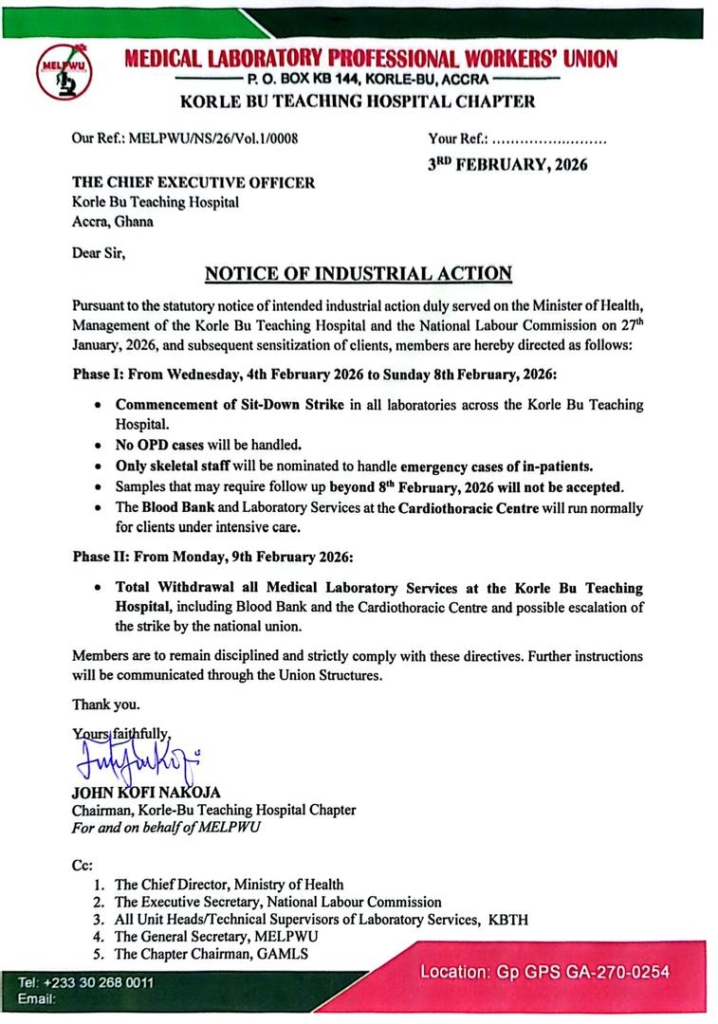
The Korle Bu chapter of the Medical Laboratory Professional Workers’ Union (MELPWU) began a sit-down strike on Wednesday, February 4, 2026, leading to reduced operations across all laboratories in the hospital. The initial phase of the action, which runs until Sunday, February 8, has already curtailed access to key diagnostic services for many patients.
According to a strike notice signed by the Chapter Chairman, John Kofi Nakoja, members have been directed to suspend all Outpatient Department (OPD) laboratory services during this period. Only a limited number of staff have been assigned to handle emergencies for admitted patients. The notice further indicated that samples requiring processing beyond February 8 will not be accepted, pointing to a gradual scale-down of services ahead of the next phase of the strike.
At present, the Blood Bank and the Cardiothoracic Centre Laboratory remain operational but are restricted to serving critical care patients only, with routine cases put on hold.
The situation is expected to deteriorate further on Monday, February 9, 2026, when the union plans to completely withdraw laboratory services at Korle Bu, including those at the Blood Bank and Cardiothoracic Centre. This would effectively shut down one of the hospital’s most essential diagnostic units.
MELPWU has also cautioned that the action could be escalated by the national union, raising the possibility of a wider, nationwide strike if engagements fail to yield results.
The industrial action follows a statutory notice of intent to strike served on the Minister of Health, the management of Korle Bu Teaching Hospital, and the National Labour Commission on January 27, 2026. While the union has not publicly outlined its specific demands, such actions are typically linked to unresolved concerns over conditions of service, allowances, logistics, and workplace safety.
Health professionals warn that a prolonged shutdown of laboratory services could severely affect non-emergency care at Ghana’s largest referral hospital, leading to delayed diagnoses, postponed surgeries, and disruptions in patient monitoring if the impasse is not resolved swiftly.